Mystery of ‘Orphan’ Gamma Rays
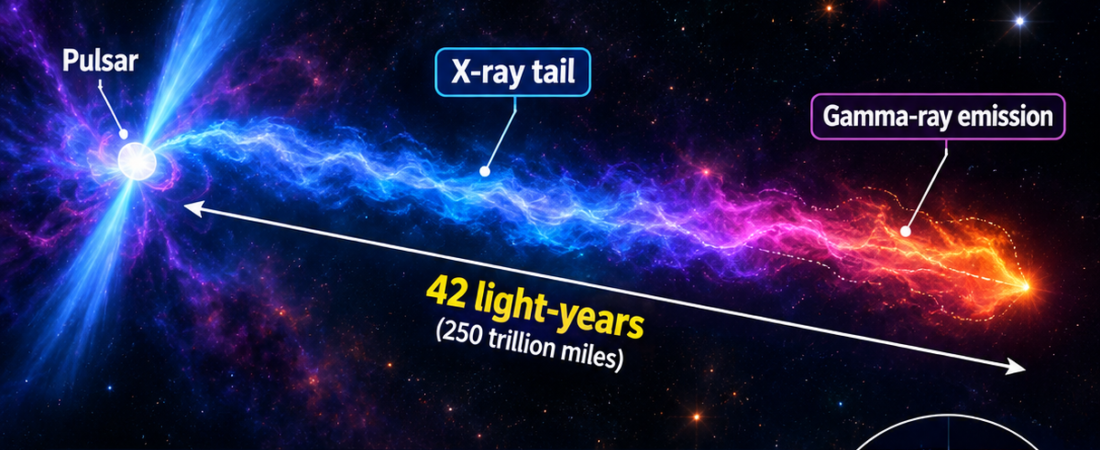
Astronomers have discovered an enormous 42-light-year-long X-ray tail extending from a pulsar located roughly 4,600 light-years from Earth. The remarkable structure was identified through observations from China’s Einstein Probe (EP) satellite and the Large High Altitude Air Shower Observatory (LHAASO).
What makes the discovery particularly important is that the X-ray structure points in almost the same direction as a previously unexplained source of ultrahigh-energy gamma rays detected by LHAASO. The close alignment between the two signals provides new evidence that the gamma rays could be connected to particles originating near the pulsar.
The findings could help scientists understand how extremely energetic particles escape their sources and travel across interstellar space.
A Giant X-Ray Structure Stretching Across Space
The newly observed X-ray feature extends approximately 42 light-years, equivalent to around 250 trillion miles. It originates near a pulsar surrounded by a region known as a pulsar wind nebula, where powerful winds of energetic particles are produced.
Previous observations had not captured the full extent of the structure. The new observations provide a much broader view, revealing how far these high-energy particles and their associated emissions may extend from the pulsar.
The pulsar itself is located approximately 4,600 light-years away, making the scale of the structure especially remarkable.
The Connection to Mysterious Gamma Rays
LHAASO has detected numerous sources of extremely energetic gamma rays in recent years. However, some of these sources appear to have no obvious astronomical object at their locations.
These sources are sometimes described as “orphan” gamma-ray sources because researchers have struggled to identify a clear object responsible for producing the observed high-energy radiation.
The newly discovered X-ray tail could provide an important clue.
Researchers found that the X-ray structure extends in a direction that closely matches the location of the ultrahigh-energy gamma-ray emission observed by LHAASO. This spatial alignment suggests that the two phenomena may be physically connected.
How High-Energy Particles Travel Through Space
Extreme cosmic objects—including pulsars, supernova remnants and black holes—can accelerate particles to enormous energies, sometimes approaching the speed of light.
Scientists have traditionally studied how these particles spread after leaving their acceleration regions. The new observations suggest that their movement may not always be completely random.
Instead, some high-energy particles could remain concentrated along a particular direction and travel tens of light-years through interstellar space.
This possibility offers a new perspective on how energetic particles move away from their original acceleration sites.
Why LHAASO’s Gamma-Ray Discoveries Matter
LHAASO is designed to detect extremely energetic cosmic radiation, including gamma rays associated with particles reaching energies above one petaelectronvolt (PeV).
Its observations have revealed a growing population of ultrahigh-energy gamma-ray sources. Yet identifying the astronomical objects responsible for some of these emissions has remained difficult.
One possible explanation is that the particles responsible for the gamma rays travel a significant distance before producing detectable radiation. If that is the case, the gamma-ray source could appear far away from the object that originally accelerated the particles.
The newly detected X-ray tail provides an example of how researchers might trace those particles back toward their source.
A New Way to Study Cosmic Particle Propagation
The discovery is significant because it gives astronomers an opportunity to investigate the journey of high-energy particles over enormous distances.
Instead of assuming that particles immediately spread equally in every direction, the observations indicate that their movement can be strongly influenced by the surrounding environment and magnetic structures in space.
Studying these long particle streams could help researchers better understand the relationship between pulsar wind nebulae, X-ray emissions and ultrahigh-energy gamma rays.
Einstein Probe and LHAASO Reveal Different Pieces of the Puzzle
The discovery highlights the value of combining observations across different forms of electromagnetic radiation.
The Einstein Probe satellite observes X-ray emissions, while LHAASO is capable of detecting extremely high-energy gamma-ray phenomena. By comparing observations from both facilities, researchers were able to identify the striking spatial relationship between the X-ray tail and the previously unexplained gamma-ray emission.
Together, the observations provide a more complete picture of what may be happening around the distant pulsar.
What This Could Mean for ‘Orphan’ Gamma-Ray Sources
The study could offer a possible explanation for some ultrahigh-energy gamma-ray sources whose origins have remained uncertain.
If energetic particles can travel far from their original acceleration sites before generating detectable gamma rays, then the apparent lack of a nearby astronomical counterpart may not mean the source is truly absent.
Instead, the actual accelerator could be located many light-years away.
Future observations of similar X-ray structures and gamma-ray sources could help determine whether this mechanism is common throughout the galaxy.
Study Published in Science China
The research was published on September 21, 2026, in Science China: Physics, Mechanics & Astronomy. The corresponding researchers are affiliated with the Institute of High Energy Physics of the Chinese Academy of Sciences and Nanjing University.
A separate commentary on the research was also published in the same issue by Gabriele Ponti and colleagues at the Italian National Institute for Astrophysics (INAF).
Final Thoughts
The discovery of a 42-light-year X-ray tail connected in direction with ultrahigh-energy gamma-ray emission gives scientists a valuable new clue about the movement of cosmic particles.
Rather than spreading immediately in every direction, some particles may travel along preferred paths for enormous distances after leaving their acceleration source. This could help explain why some of LHAASO’s most energetic gamma-ray sources appear to have no obvious counterpart.
As astronomers continue combining X-ray and gamma-ray observations, structures like this could reveal more about how the universe transports some of its most energetic particles across interstellar space.