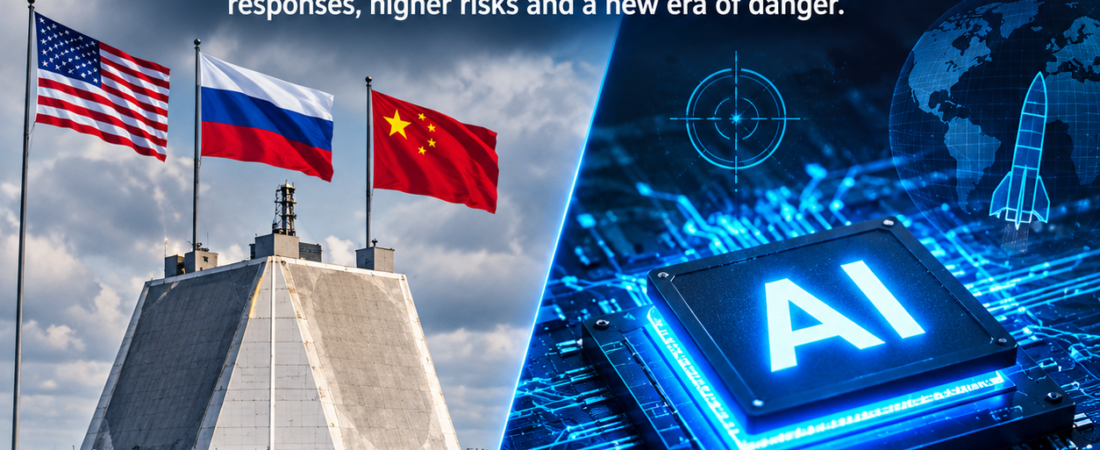
AI Is Changing Nuclear Early-Warning Systems
Artificial intelligence is moving into one of the world’s most sensitive areas: nuclear security and early-warning systems.
The United States, Russia and China are all developing advanced military AI capabilities, while research indicates that AI is increasingly being considered or integrated into nuclear-related systems, including missile early warning, intelligence analysis and nuclear command, control and communications.
The basic idea is straightforward: AI can process enormous amounts of information much faster than humans. Satellites, radar systems, sensors and intelligence networks can generate huge volumes of data, and AI could help identify patterns that might indicate a potential missile launch or military movement.
However, nuclear decision-making presents an unusual challenge. A system that makes an ordinary analytical mistake can be corrected. A false warning involving nuclear weapons could have consequences that are far more serious.
How AI Could Detect a Missile Threat
Traditional early-warning networks rely on technologies such as satellites, radar and other sensors to detect possible missile launches.
AI can potentially sit on top of these systems and analyze incoming information rapidly.
For example, an AI-enabled system could examine:
- Satellite imagery
- Radar information
- Infrared observations
- Signals intelligence
- Military movements
- Changes at missile facilities
- Large volumes of historical data
AI-based analytical systems could then highlight unusual activity for human analysts to investigate.
Research published by the Council on Strategic Risks has examined how AI-enhanced intelligence, surveillance and reconnaissance could potentially identify changes in the status or movement of nuclear forces and alert human analysts.
The important point is that AI detection does not necessarily mean AI makes the final nuclear decision.
Why the U.S., Russia and China Are Interested in AI
The nuclear environment is becoming more complicated as China expands and modernizes its nuclear capabilities while the United States and Russia continue to maintain and modernize large nuclear arsenals.
A 2025 analysis from the Center for a New American Security examined the growing intersection between AI and nuclear weapons involving all three countries. It identified several areas where AI could affect nuclear security, including nuclear command and control, the broader nuclear balance and conventional military systems that could interact with nuclear risks.
A separate 2026 SIPRI study examining China, India and the United States found increasing signs that AI is being integrated into nuclear and nuclear-related systems, while also noting differences in transparency among the countries.
This makes AI part of a much larger technological competition involving satellites, cybersecurity, computing power, autonomous systems and advanced military intelligence.
The Biggest Potential Advantage: Speed
One of the main reasons militaries are interested in AI is speed.
Humans can analyze information carefully, but they cannot process millions of data points simultaneously at machine speed.
AI systems can potentially:
Collect → Analyze → Detect patterns → Flag anomalies → Alert human operators
This could give decision-makers additional time to examine a potential threat.
Researchers at Chatham House have noted that AI-assisted early warning could potentially provide leaders with more time to assess a situation and consider de-escalation.
That potential benefit, however, depends heavily on the accuracy and reliability of the AI system.
The Dangerous Side of AI Nuclear Warning Systems
The same speed that makes AI attractive can also create a serious problem.
Imagine an AI system incorrectly interprets an unusual event as evidence of a missile launch.
If that warning reaches military decision-makers during an already tense international crisis, humans may have less time to investigate the information.
This creates the possibility of a false positive.
A false positive occurs when a system identifies a threat that does not actually exist.
This is not simply a theoretical concern. During the Cold War, early-warning systems produced false alarms. One of the most well-known incidents occurred in 1983, when a Soviet warning system incorrectly indicated that the United States had launched missiles. The officer responsible judged the warning to be false, and the alert was not treated as a real attack.
AI introduces a modern version of the same challenge: How much should humans trust an extremely fast machine-generated warning?
AI Hallucinations Are Another Concern
Modern AI systems can sometimes produce confident but incorrect information.
This problem is often called an AI hallucination.
In ordinary applications, an incorrect AI answer might be inconvenient.
In military intelligence, however, an incorrect interpretation could potentially influence real-world decisions.
SIPRI has identified several technical challenges associated with advanced AI in the nuclear domain, including unreliable outputs, cyberattack vulnerabilities, insufficient data quality and limitations in computing and technical infrastructure.
That is why researchers emphasize that AI should not simply replace human judgment in sensitive nuclear decisions.
Human Control Remains a Major Issue
One of the central questions surrounding AI and nuclear weapons is how much authority an AI system should have.
The United States and China have publicly supported the principle that AI should not replace human judgment in decisions involving nuclear weapon use. Arms Control Today reported in 2025 that the two countries had expressed a growing consensus that nuclear launch authorization should remain a human responsibility.
This creates an important distinction:
AI-assisted decision-making
AI analyzes information and provides recommendations, while humans evaluate the information and make decisions.
AI-controlled decision-making
An automated system could potentially take increasingly independent actions.
The second model raises considerably more questions about accountability, reliability and escalation.
AI Could Also Improve Situational Awareness
AI is not only about detecting missile launches.
It can potentially assist with broader intelligence analysis.
For example, AI could analyze satellite imagery over time and identify changes such as:
- Movement of military vehicles
- Changes around missile facilities
- Construction activity
- Deployment patterns
- Changes in military readiness
- Unusual activity across large geographic areas
The advantage is that AI can continuously compare new information against previous observations.
Researchers have therefore been examining AI applications across the wider nuclear command, control and communications environment rather than focusing exclusively on missile launches.
Cybersecurity Becomes Even More Important
Adding AI to nuclear-related systems also creates another challenge: cybersecurity.
A sophisticated AI system depends on data, software, communications networks and computing infrastructure.
If an attacker could manipulate the information entering such a system, the AI might produce an incorrect assessment.
SIPRI specifically identifies susceptibility to cyberattacks as one of the challenges associated with advanced AI integration into the nuclear domain.
This means that securing AI systems is not simply about protecting the AI model itself. The surrounding infrastructure and data must also be protected.
The U.S., Russia and China Face a New Strategic Environment
The combination of nuclear weapons and artificial intelligence creates a new technological environment.
The three countries have different military structures, nuclear doctrines and levels of transparency, so their approaches to AI are not identical.
Research from SIPRI notes that publicly available information about nuclear command and control differs significantly between countries, making it difficult to establish exactly how AI is being used across all nuclear-related systems.
Therefore, claims that all three countries are using AI in exactly the same way should be treated cautiously.
What is clearer is that AI has become an important part of discussions about the future of nuclear warning, intelligence and command systems.
Why AI Speed Can Create a Paradox
AI creates an interesting paradox.
On one side:
Faster analysis → More information → Earlier warning → More time for humans to respond
But on the other:
Faster analysis → Less time to question the result → Faster escalation if the information is wrong
This is why AI accuracy and human oversight are so important.
The technology itself does not automatically make nuclear systems safer or more dangerous. Its effects depend on how it is designed, what information it receives, how much authority it has and how humans use its outputs.
Experts Are Calling for Stronger AI Safeguards
The debate is increasingly moving beyond technology toward international safeguards.
In September 2026, U.S. and Chinese security experts proposed safeguards for military AI, including maintaining human control over critical systems, establishing boundaries around nuclear applications and improving communication channels for AI-related incidents. These proposals were made by experts and have not been formally adopted as government policy.
Such discussions reflect a broader concern: when multiple countries develop increasingly powerful military AI systems at the same time, misunderstandings could become harder to manage.
What Does the Future of AI and Nuclear Weapons Look Like?
The future is still uncertain.
AI could potentially make early-warning systems more capable by processing information rapidly and identifying patterns that humans might miss.
At the same time, integrating AI into nuclear-related systems introduces questions about:
- Accuracy
- False alarms
- Cybersecurity
- Data quality
- Human oversight
- Accountability
- International communication
- Escalation during crises
A 2025 CNAS report argues that the risks of AI in the nuclear environment depend partly on the role humans retain, whether AI becomes a single point of failure and how AI changes the balance between offensive and defensive capabilities.