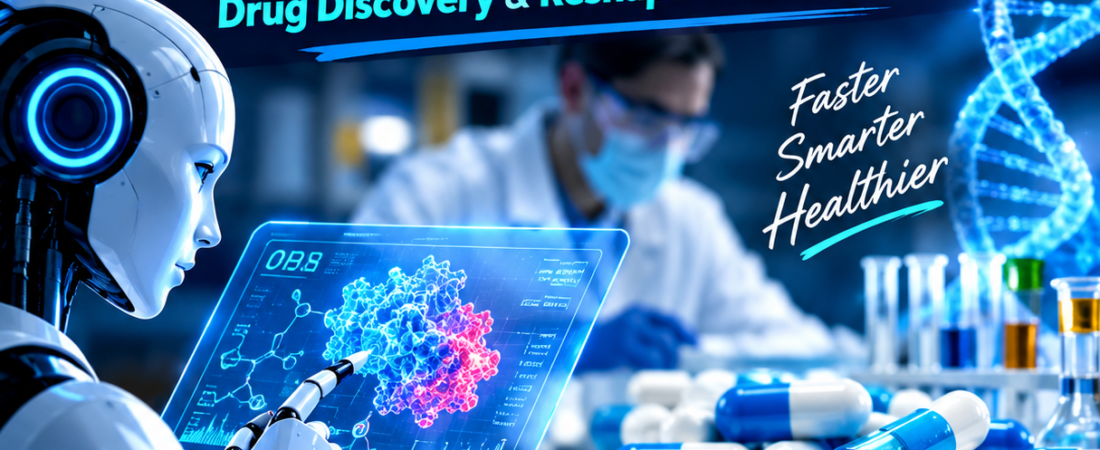
AI in Biopharma: How Artificial Intelligence Is Transforming Drug Development
Artificial intelligence is no longer just a technology used for writing, automation, or simple data analysis. AI become more advance day by day. The pharmaceutical industry is increasingly using AI across research, drug development, manufacturing, and business operations.
As major pharmaceutical companies invest heavily in artificial intelligence, a growing number of biotech startups are also using AI to explore new approaches to drug discovery. The technology is helping researchers process large amounts of information, identify opportunities faster, and potentially reduce some of the time and cost involved in developing medicines.
Why AI Is Becoming Important in Biopharma
Developing a new medicine is a complex and expensive process. Researchers have to analyze huge amounts of biological and chemical data, identify potential drug candidates, test them, and move successful candidates through multiple development stages.
AI can assist with many of these tasks by analyzing information at a scale that would be difficult to manage manually.
Pharmaceutical companies are therefore exploring AI for areas such as:
- Drug discovery and candidate identification
- Research and development
- Data analysis
- Clinical development
- Manufacturing automation
- Business operations
- Healthcare and patient support
This broader adoption is changing the role of technology inside the pharmaceutical industry.
Big Pharma Is Increasing Its AI Investment
The growing importance of AI can be seen in discussions among pharmaceutical executives.
Pfizer CEO Albert Bourla has highlighted artificial intelligence as an important opportunity for improving productivity and accelerating research and development. Pfizer has also used AI as part of its efforts to integrate Seagen, the cancer-focused company it acquired for approximately $43 billion in 2023.
According to Bourla, AI can contribute to faster R&D processes and greater productivity across the company.
This reflects a broader trend: pharmaceutical companies are increasingly treating AI as a strategic business technology rather than an experimental tool.
AstraZeneca Sees AI Improving Drug Development
AstraZeneca is another major pharmaceutical company exploring the potential of artificial intelligence.
Pam Cheng, the company’s executive vice president for global operations and chief sustainability officer, has said that AI is producing measurable efficiencies across research and development and other operations.
AI can potentially help pharmaceutical companies:
- Reduce drug development timelines
- Automate selected manufacturing processes
- Improve operational efficiency
- Analyze complex information more effectively
- Support earlier and more precise healthcare
The technology may therefore influence more than just laboratory research. Its impact can extend into manufacturing and other parts of the pharmaceutical supply chain.
AI Could Speed Up Drug Discovery
One of the biggest opportunities for artificial intelligence in biopharma is drug discovery.
Researchers often have to examine enormous datasets when searching for promising molecules and understanding how potential medicines may interact with biological targets.
AI systems can help analyze these datasets and identify patterns that may otherwise take significantly longer to uncover.
This does not mean AI completely replaces scientists. Instead, it can provide researchers with additional tools for analyzing information and prioritizing areas that deserve further investigation.
AI Is Changing Pharmaceutical Operations
The influence of AI is also expanding beyond laboratories.
Pharmaceutical companies are exploring automation and machine-learning systems for manufacturing, supply-chain management, research operations, and other business processes.
Automation can reduce repetitive manual work while allowing employees to focus on tasks requiring human judgment and expertise.
As these systems become more integrated, technology is becoming a larger part of everyday pharmaceutical operations.
The Rise of AI-Driven Biotech Startups
Large pharmaceutical companies are not the only organizations investing in AI.
A growing group of biotechnology startups is building businesses around artificial intelligence and machine learning. These companies are applying AI to areas such as molecular research, protein analysis, drug candidate discovery, and biological data.
The emergence of these companies is creating a closer relationship between the technology and biotechnology industries.
Instead of AI simply supporting traditional pharmaceutical research, some companies are designing their drug-discovery processes around computational technologies from the beginning.
The Line Between Technology and Pharma Is Blurring
The pharmaceutical industry is becoming increasingly connected with the technology sector.
Companies that once depended primarily on laboratory research are now investing in software, machine learning, automation, cloud computing, and advanced data systems.
At the same time, technology companies and AI-focused startups are becoming increasingly interested in healthcare and biotechnology.
This convergence could reshape how medicines are researched, developed, manufactured, and eventually delivered to patients.
What Does AI Mean for the Future of Medicine?
The long-term impact of AI in healthcare and biopharma is still developing.
Artificial intelligence could help researchers handle complex scientific datasets, identify promising drug candidates, automate certain processes, and improve operational efficiency. However, AI-generated insights still require scientific validation, testing, regulatory review, and human expertise before they can become approved medical treatments.
The most significant change may therefore be the way scientists and AI systems work together.
Rather than replacing researchers, AI is becoming another powerful tool within the pharmaceutical development process.
Artificial intelligence is moving from an emerging technology to an increasingly important part of the biopharmaceutical industry.
Companies such as Pfizer and AstraZeneca are exploring AI to improve research, productivity, manufacturing, and other operations, while AI-focused biotech startups are developing new approaches to drug discovery.
As investment and adoption continue, the relationship between AI, biotechnology, and pharmaceutical research is likely to become even closer.
For the pharmaceutical industry, the AI revolution is not simply about using a new piece of software. It is about changing how scientific information is analyzed, how medicines are developed, and how the industry operate.