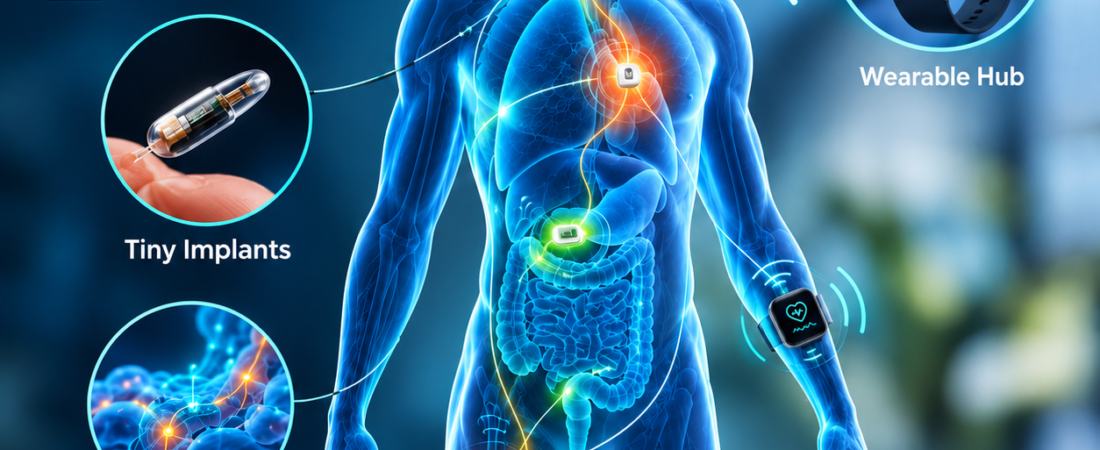
Scientists Turn the Human Body Into a Wireless Network for Tiny Medical Devices
Imagine a tiny sensor inside the body detecting a biological signal and immediately sending a message to another device somewhere else in the body — without wires, Bluetooth, or a direct physical connection.
That is the idea behind a new wireless networking technology developed by engineers at Georgia Tech.
The researchers have created a system called SWANS — Smart Wireless Autonomous Networking System — that allows tiny implantable sensors, therapeutic devices and wearable electronics to communicate through the body’s own tissues. The work was reported September 24, 2026, in the journal Science. (Georgia Tech News)
How Can the Human Body Carry Signals?
Traditional wireless technologies such as Bluetooth and NFC are not particularly well suited to communication between devices inside and outside the body.
According to Georgia Tech, conventional systems can require antennas and relatively significant power, which can make implantable electronics larger and more difficult to deploy.
SWANS takes a different approach.
Instead of relying on conventional radio communication, the system uses the natural ionic conductivity of body tissue to carry very small electrical signals between devices. (Georgia Tech Engineering)
In simple terms, the researchers are using the body’s own tissue as part of the communication network.
What Is SWANS?
SWANS stands for Smart Wireless Autonomous Networking System.
The technology is designed to allow multiple small devices to communicate and coordinate their actions throughout the body.
A sensor in one location could detect a biological event, for example, while an actuator positioned somewhere else could respond to that signal.
The devices do not need to be physically connected or positioned close together. Georgia Tech says the approach could potentially connect devices located in very different parts of the body, including locations deep inside the stomach. (Georgia Tech Engineering)
How the Tiny Medical Network Works
Each implant can be programmed to recognize electrical pulses with specific characteristics, including their voltage and duration.
When a particular signal travels through the surrounding tissue, the appropriate device can recognize it and activate.
This allows different implants to be assigned different responses.
Multiple sensors can also work together. Information detected by several devices can be coordinated so that a specific signal eventually triggers another device to perform an action.
The researchers describe this as a network that can connect sensing and therapeutic functions across the body.
Implants Smaller Than 3 Millimeters
One of the most striking aspects of the technology is its potential size.
Georgia Tech researchers report that their low-power approach can support implantable devices smaller than 3 millimeters — small enough to be delivered through a syringe rather than requiring a conventional surgical implantation procedure. (Georgia Tech Engineering)
The devices use passive electronic components that consume essentially no power while waiting for a triggering signal.
Once the appropriate signal is received, the device can activate and perform its programmed function.
Smaller electronics could be particularly useful for future bioelectronic medicine because implant size can affect how and where a device can be placed.
Extremely Low Power Consumption
Power efficiency is another important part of SWANS.
Because the tiny implants can remain largely inactive until they receive a specific trigger, they require very little energy.
In the researchers’ experiments, a small actuator activated once per day was estimated to operate for roughly one year before needing replacement. The team also reported that the electrical pulses used in its experiments did not damage tissue samples. (Georgia Tech Engineering)
These findings are from the research experiments and do not mean the technology is already approved for human medical use.

A Rat Demonstration Connected Two Limbs
The researchers demonstrated the networking concept using a rat.
They created a network involving sensors and neural interfaces that could coordinate activity between the animal’s limbs.
When sensors detected movement of the rat’s front paw, the system automatically triggered another device that stimulated and contracted a muscle in the hind leg.
The researchers used this setup to reproduce a coordinated walking-like movement between the two limbs. (Georgia Tech Engineering)
The experiment demonstrates the communication concept rather than proving a finished medical treatment for humans.
What Could This Technology Eventually Do?
The potential applications are broad.
A future system could theoretically allow a sensor to detect a particular biological condition and communicate with an actuator positioned elsewhere in the body.
Depending on future development and medical validation, such networks could potentially support technologies for:
- Drug delivery
- Neural stimulation
- Physiological monitoring
- Bioelectronic medicine
- Prosthetic control
- Automated therapeutic responses
- Wearable-to-implant communication
The key concept is that the sensing device and therapeutic device would not have to be located next to each other.
Why Conventional Wireless Signals Are a Challenge
Devices such as smartphones and wireless wearables commonly rely on radio technologies such as Bluetooth.
Inside the human body, however, transmitting conventional wireless signals presents additional engineering challenges.
Georgia Tech researchers say the body’s properties make technologies such as Bluetooth and NFC difficult to use efficiently for communication with tiny implants. Conventional wireless systems can also require antennas and power sources that take up valuable space. (Georgia Tech Engineering)
SWANS attempts to avoid some of those limitations by using the body’s ionic conductivity instead.
SWANS Transmits Small Amounts of Data
The system is not intended to replace conventional wireless networks for transferring large files or large quantities of information.
Instead, SWANS is designed for small, simple signals.
For example, a device might communicate that a particular condition has been detected or send a basic yes/no instruction telling another device to activate.
More complicated data processing and larger information transfers can be handled by an external wearable hub.
That hub can coordinate information from multiple implants and then help direct therapeutic actions. (Georgia Tech Engineering)
Toward Personalized Bioelectronic Medicine
The researchers see the technology as part of a broader effort to make medical treatments more responsive and automated.
Instead of relying entirely on scheduled treatments or manual intervention, future systems could potentially detect a biological signal and respond at the appropriate location.
This could eventually allow therapies to be delivered more precisely, although substantial additional research and clinical testing would be required before such applications could be used routinely in people.
The Bigger Picture
SWANS represents a different way of thinking about medical implants.
Rather than treating every implant as an isolated device, the researchers are exploring the possibility of creating a network of tiny devices distributed throughout the body.
One device could sense something. Another could interpret or relay a signal. A third could perform an action.
That architecture resembles, in concept, the way different parts of the nervous system communicate and coordinate functions — although SWANS is an engineered electronic system, not a biological nervous system. (Georgia Tech Engineering)
What Comes Next?
The current research is an experimental demonstration, not a finished medical product.
Future work will need to address questions around long-term safety, reliability, implantation, power management, device longevity, communication performance and regulatory approval before the technology could become part of routine human healthcare.
Still, the ability to create extremely small implantable devices that can communicate through body tissue could open new possibilities for bioelectronic medicine and wearable healthcare technology.