How much time you spend sitting throughout the day
For many office workers, reaching a daily step target can feel like a sign that they have been active enough. But there is another side of the story that is easy to overlook: how much time you spend sitting throughout the day.
A person might walk in the morning, complete a workout in the evening and still spend most of the remaining hours sitting behind a desk, inside a car or at home.
This pattern is becoming increasingly common as work and daily life become more dependent on screens, desks and transportation.
A Typical Working Day Can Involve Hours of Sitting
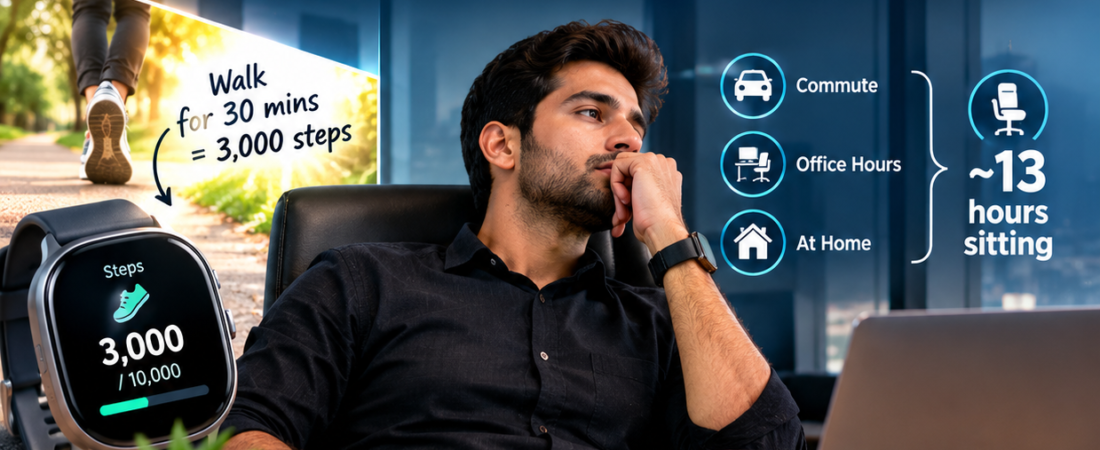
Consider the routine of Areeb Ahmed, a working adult who starts his morning with Fajr prayer and a roughly 30-minute walk. That walk gives him around 3,000 steps before his workday even begins.
After that, however, his activity drops considerably.
He drives to work and spends around nine to ten hours at his desk. His smartwatch regularly reminds him to get up and move, so he takes short breaks during the day. Each break may add around 200 to 250 steps, eventually helping him accumulate another couple of thousand steps before leaving work.
He also tries to walk for about 30 minutes after Maghrib. If he still has steps left to complete, he adds another walk after Isha.
Despite all of this movement, Ahmed estimates that he can spend roughly 13 of his 17 waking hours sitting.
His experience reflects a much wider challenge facing people with desk-based jobs.
Pakistan’s Urban Lifestyle Is Becoming More Sedentary
In many Pakistani cities, sitting has become part of the normal daily routine.
People drive or ride even for relatively short journeys, spend long hours at office desks and then return home to smartphones, televisions or computers.
Shehzar Muhammad, a fitness professional and gym owner, points to the same pattern among corporate workers. Employees working traditional 9-to-5 schedules can remain indoors and seated for much of the day, while commuting by car or motorcycle adds very little physical movement.
Over time, this lifestyle can be associated with problems such as stiffness, poor posture and lower-back discomfort.
Being Inactive and Sitting Too Much Are Not Exactly the Same
Physical inactivity and sedentary behavior are often treated as the same thing, but they describe different situations.
Physical inactivity generally refers to not getting enough physical activity or exercise.
Sedentary behavior, on the other hand, involves spending extended periods sitting or reclining while using very little energy.
That distinction matters because someone can exercise regularly and still have a highly sedentary lifestyle.
The “Active Couch Potato” Effect
This is where the idea of an “active couch potato” comes in.
Someone might complete a morning run, visit the gym after work or reach a particular step target. But if most of the rest of the day is spent sitting continuously, that exercise does not automatically cancel out prolonged periods of inactivity.
The solution is not necessarily to spend hours exercising.
Instead, people can look for opportunities to break up long periods of sitting.
A few minutes of movement throughout the day can be easier to maintain than trying to compensate for an entire day of sitting with one workout.
Simple Ways to Move More During the Workday
Small changes can make movement a more regular part of the day.
- Set an alarm or smartwatch reminder to stand up.
- Walk around during short breaks.
- Avoid staying in the same chair for several hours.
- Walk while taking a phone call when possible.
- Take a few minutes to stretch between tasks.
- Walk to a nearby colleague instead of always sending a message.
- Add a short walk before or after work.
- Look for opportunities to walk during daily errands.
The goal is not simply to chase a number on a smartwatch. It is to create a routine where movement is spread throughout the day.
Why Breaking Up Sitting Matters
Modern work makes prolonged sitting almost unavoidable for many people. However, sitting for hours without interruption doesn’t have to be the default.
A short movement break can provide a simple way to interrupt long periods of inactivity.
For someone who spends most of the day at a desk, getting up regularly may be more realistic than trying to add another intense workout to an already busy schedule.
The Bigger Picture
Daily steps and exercise are useful measures of physical activity, but they don’t tell the whole story.
A person can technically reach a step goal while still spending most of the day sitting.
That is why the modern approach to staying active should include both planned exercise and regular movement throughout the day.
For office workers, students and anyone who spends long hours behind a screen, the message is simple:
Don’t wait until your workout to move. Get out of the chair regularly and keep moving throughout the day.